
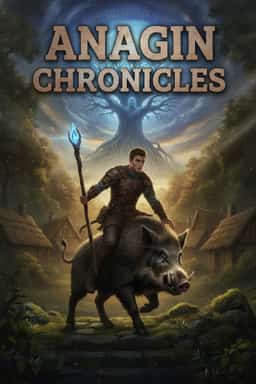
Chapter 152. Seizing Merit (1)
“You’re quick to catch on.”
Half sarcasm, half sincere.
He’d expected him to still be held up by the practitioners, rambling on about the Temple of Delphi.
But before he knew it, Orpheus had already overtaken him and was waiting ahead on the road Anagin had been taking.
“How did you know I was here?”
“I’ve got good instincts.”
“That’s strange. You wouldn’t have figured it out on instinct alone.”
Orpheus spoke gently, but the meaning beneath it was firm.
He was certain that Anagin couldn’t have noticed him by instinct alone.
Anagin wanted to tell him to stop talking nonsense, but honestly, Orpheus was right.
Having sharp instincts was one thing, but finding Orpheus purely through instinct wasn’t it.
Back in the waiting room of the Temple of Delphi, when Orpheus returned earlier than expected, Anagin hadn’t been startled for no reason.
He truly hadn’t sensed Orpheus approaching.
‘Still… a conversation first…?’
Watching Orpheus continue talking instead of acting immediately, Anagin organized his thoughts.
“…The terrain changed.”
He mentioned the subtle shift in the surroundings compared to when he had stayed in the Festival Village and surveyed the area.
He had noticed the change right after speaking with Sphinx. When Orpheus had interfered even with Sphinx’s eavesdropping, something clicked in his mind, and he recognized the altered terrain.
And instinctively, he became certain Orpheus was nearby.
Not through rational deduction, but instinct.
And that instinct was correct. Unfortunately.
“So you weren’t just sightseeing. A rare kind of young man these days.”
“I was sightseeing. I just… made good use of the time in between… more importantly, what do you want?”
After seeing everything there was to see and parting on good terms, yet waiting here like this—
No matter how he tried to interpret it kindly, it didn’t seem like it was for anything good.
“First, let’s say I want to have a more honest conversation with you.”
“First, huh……”
Anagin rolled the word “first” around in his mind.
As if there was a real purpose that would come after.
“Well, fine. Let’s talk.”
Deciding to face it rather than avoid it, Anagin sat down on a cut tree stump.
“Alright, what do you want to say?”
“Could you tell me in more detail? About the shitty thing you said you went through?”
“……”
Anagin didn’t answer. He simply closed his mouth and stroked his chin.
It wasn’t because he was flustered. He had a feeling something like this might come up. It was just……
“Why are you asking that?”
“It’s only natural to be curious about the circumstances of a practitioner who shares the same goal of becoming a god as I do, isn’t it?”
At first glance, it made sense.
But Anagin couldn’t agree.
“I’m not the same as you.”
“I agree. Our goal may be the same, but the process is the exact opposite. Or perhaps even the goal itself is opposite.”
Interestingly, Orpheus agreed. Not just pretending—he genuinely seemed to recognize the difference between himself and Anagin.
They both aimed to become gods.
But the specific god they aimed for was different.
Orpheus was fine serving under another god, while Anagin was not.
Because of that difference, Orpheus sold his merit and received a blessing, while Anagin kept his merit and refused any blessing.
Similar, yet completely different.
“Perhaps it’s because we are different that I ask. So I request this of you. What is your specific reason for wanting to become a god?”
He had appeared out of nowhere, used his blessing to tamper with the surroundings, but the request itself felt sincere.
The word “request” carried weight.
Maybe because of that, Anagin answered without much resistance. It wasn’t exactly a secret anyway.
“Where should I start?”
He hesitated as if it were hard to explain, but once he began speaking, the words flowed smoothly.
The winter just before he turned twenty. The sudden outbreak of a plague.
The first to die was an old villager, but soon the disease spread throughout the entire village, and people began dying one by one.
“I was the only one who could still move, so I had to dig all the graves myself.”
He explained why he had become so skilled with a shovel.
No one had asked, but he just felt like saying it.
Wasn’t it unfair? Digging graves alone all winter.
“That must have been difficult.”
“It was just annoying.”
For Anagin, a Gigant, digging wasn’t hard. If anything, it was closer to being a nuisance.
Honestly, he could dig the ground with his bare hands without even using a shovel. Punch the earth, and a hole forms.
He only used a shovel because leaving it like that didn’t feel right for a grave.
“Then you must have buried your loved ones as well.”
“Loved ones?”
“Your father, mother, siblings… or perhaps a lover. Did you have one?”
“No, not a lover… but there were a few girls who showed interest in me.”
Anagin recalled the girls he used to hang out with.
Maybe because it had been so long, his head throbbed slightly.
“Sounds like you were popular.”
“I’m pretty handsome. And if you lived with me, you’d get to eat meat every day.”
“Haha… Did you pray?”
“Hmm?”
“When they were dying from the illness… did you pray?”
“No.”
Anagin’s voice, which had softened slightly while recounting the past, turned firm again.
“I don’t have a hobby of begging.”
“Prayer is neither begging nor a hobby. When a great calamity or unknowable malice descends, it is the last act a human can take.”
“That’s begging.”
Even as he refuted Orpheus, Anagin listened closely to his voice.
A voice was another language. Even the slightest tremor, pitch, and tone revealed a person’s emotions.
And that included the listener’s reaction as well.
Emotions were something shared, like a disease.
Taking it all together, Anagin reached a conclusion.
“You’ve lost a lover before, haven’t you?”
“She was my wife.”
Correct.
It wasn’t anything special.
Just from the way he asked about a lover and about prayer, it was easy to figure out with a bit of thought.
Strangely, Anagin became curious about who Orpheus’s wife had been. Not much, but a little.
Normally, he wouldn’t care about some woman whose face he didn’t even know.
Then again, what did the reason matter? If he was curious, he could just ask.
“So how did she die?”
“She stepped on a venomous snake hiding in the bushes.”
“Hah……!”
Anagin let out a sound of disbelief. It was unclear whether he was laughing or sighing.
The wife of a great hero—one that even the New Argonaut Expedition Team would tread carefully around—lost her life to nothing more than a snake in the bushes.
It almost felt half-hearted.
If it were an old tale, it would be criticized as being poorly written.
But because of that, Anagin believed him.
Because he, too, had lost his family and hometown in such an absurd way.
Death came suddenly, emptily.
To the point, it almost felt like a joke.
“My wife… it may sound cliché, but she was my entire world. When she died, it was as if my world died as well.”
“And?”
Anagin didn’t offer any comfort.
He already knew how meaningless empty consolation was.
More importantly, that wasn’t the point of this conversation.
“I played the lyre. Every single day, like a madman. Before she came into my life, that was all I had. I played, and played, and kept playing.”
Orpheus gently plucked the lyre he always carried at his side.
“Then, at the moment I wondered if it would be better to end my own life, I received a revelation. That if I went to the Temple of Delphi, I would find an answer……”
Anagin said nothing, simply watching Orpheus.
As if telling him to continue.
He felt like he already knew how the story would end.
Perhaps sensing that, Orpheus continued his explanation.
“Once I went to the Temple of Delphi, it really did give me an answer. That only a god can transcend death.”
“So you decided to become a god? To bring your dead wife back to life.”
“That’s right. Doesn’t it make sense? If I become a god, I can revive my wife.”
He wanted to ask why he didn’t just ask a god to bring her back instead, but Anagin said something else.
Something deeply personal, unnecessary to say, but spoken on a whim. It was……
“I prayed once too.”
“…Did you?”
“When my father, mother, and almost everyone in the village had died, and only my little sister and I were left… I prayed just once, looking up at the stars, begging them to save her.”
To be precise, he had prayed to every being capable of resolving the situation, including the auditory hallucinations that regularly spoke to him. He promised to do anything if they would help just this once.
Just once, he said. If they helped him, he would do anything.
“You must have cherished your sister greatly.”
“She was someone I had to take responsibility for.”
At this point, he had to admit it.
He really didn’t want to, but Anagin was feeling a sense of kinship with Orpheus.
As someone who had lost what was precious and now aimed to become a god to escape that pain and emptiness.
A kind of minimal respect for someone he shared that with, perhaps.
As if Orpheus felt something similar, he asked cautiously,
“Did the god answer your prayer?”
“No…… not at all.”
Anagin recalled that moment.
The first time he had ever prayed in his life.
The moment he lowered his pride and knelt.
The moment he helplessly tried to pass off what he should have done himself onto something else.
The sky was dark, the stars were shining, and the air was cold.
There was no change. No revelation.
The next day, his sister died.
“That’s unfortunate.”
“What’s unfortunate about it?”
At that question, Orpheus’s brow furrowed slightly.
He seemed to want to ask what Anagin meant, but instead said something else.
“Have you changed your mind?”
“About what?”
“About becoming a god through a blessing. Do you truly have no intention? If you become a god, your sister, no, everyone you held dear, can be brought back. Isn’t that why you want to become a god in the first place?”
“Hah…!”
Anagin let out a short laugh at the foolishness of it.
Perhaps offended by being laughed at after speaking with concern, Orpheus pressed him—something rare for him.
“What’s so funny?”
“Because it’s stupid. I already told you why I want to become a god back in the Temple of Delphi waiting room, but you’re talking about something else.”
“You mean… to not feel powerless?”
“Yeah.”
Anagin answered briefly and firmly.
As if it were the absolute truth.
“That’s…… truly your reason for becoming a god?”
For a moment, Anagin thought Orpheus was surprisingly dense.
Someone called a “musician” should naturally have a good ear, yet he couldn’t even distinguish truth from lies.
“Is that strange?”
“It is…… You aim to become a god, yet instead of reviving those you love, you choose to protect some petty pride? What meaning does that even have?”
“I was their pride.”
Anagin recalled his life back in his hometown.
He had a foul mouth and a bad attitude, but regardless, he had been the pride of the village.
Even while grumbling, he was the hero who protected the village from savage beasts.
Naturally, his father, his mother, and above all, his younger sister were proud of him.
“So I’ll never do something that would make me ashamed.”
Anagin’s pride wasn’t his alone.
It was something the entire village had built.
“Don’t you want to see the people you love again?”
“I do.”
He admitted it without forcing a denial. Of course, he wanted to see them. But……
“That’s exactly why I won’t revive them. The moment I do, they’ll stop being something precious.”
“What do you mean by that?”
“You know, so why ask? If someone you brought back to life died again, would you grieve? Or would you think, ‘It’s fine, I can just bring them back again’?”
Life was precious for only one reason: there was only one of it, and it couldn’t be undone.
Whether it was your own life or someone else’s.
But if that rule was broken?
Then life could no longer be called life. The same went for people.
Paradoxically, there were things that had to remain lost precisely because they were precious.
To reject that was to dishonor what made them precious in the first place.
Hearing something he already knew, Orpheus’s expression turned grim.
“As I thought… You and I are similar, yet different. Far too different.”
Having heard everything, it seemed he had given up on persuading him.
Anagin stood up and stretched his body with a crack.
“I’ll be honest. I didn’t tell you that just because I felt a sense of kinship, or because I thought your talent was too valuable to waste.”
“I know.”
“It was to build up my merit. Persuading fools who reject a god’s blessing is also recognized as a form of merit.”
“But I refused. What a shame, huh?”
“It’s fine. Though I don’t like it, I’ll earn merit in another way.”
Ting—!
As Orpheus plucked the lyre, a small ripple spread through the air, and the surroundings trembled.
The ground, the grass, the trees—even the air itself.
“There are no personal feelings involved.”
“Same here.”
At the same time he answered, Anagin kicked off the ground and charged at Orpheus.
Orpheus plucked the lyre.
The two collided.
__________________
__________________
__________________
(T/N): A rare moment of rawness for Anagin.
We all know, life is really a one-time thing, so make your life worthwhile.